
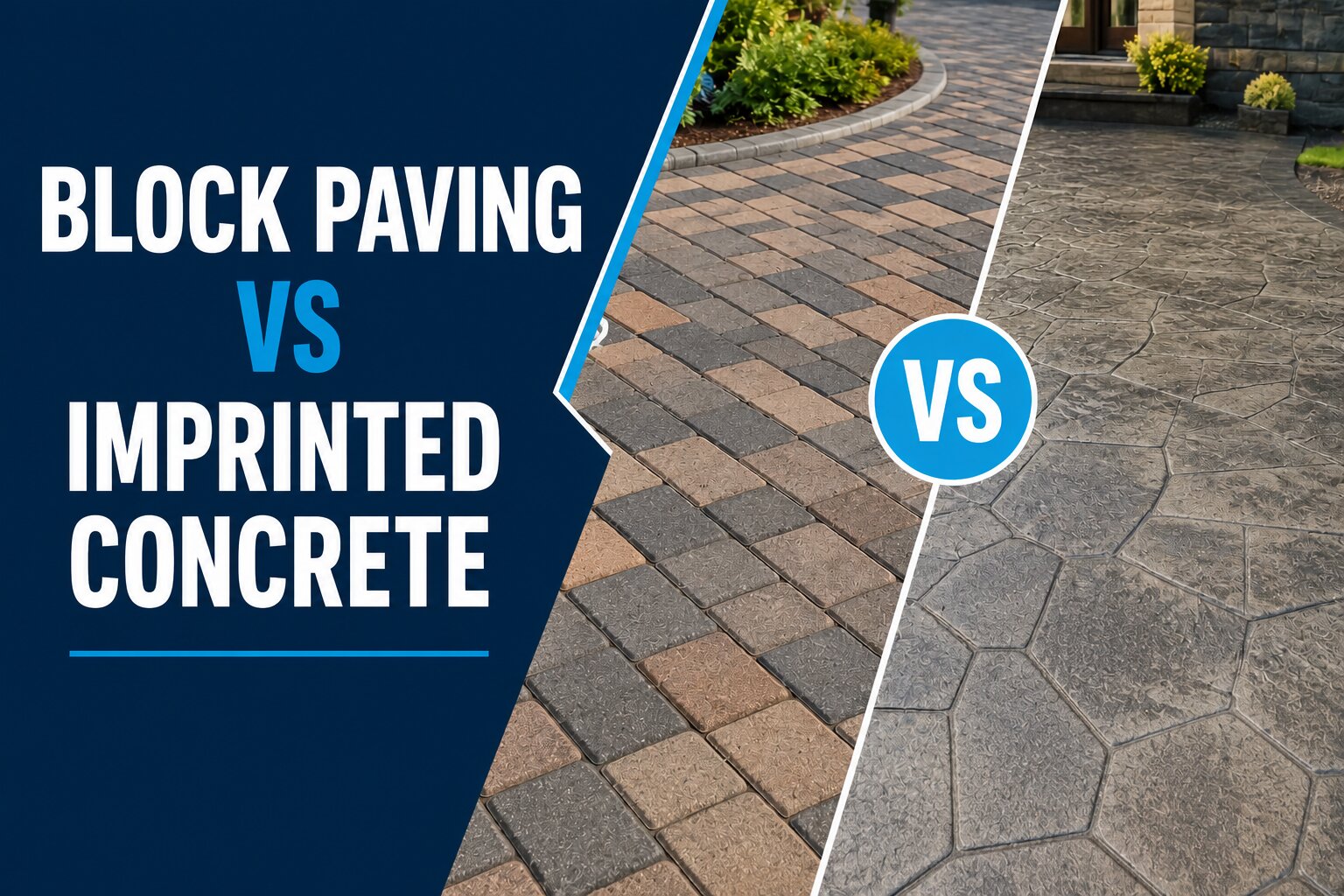
Block Paving vs Imprinted Concrete: UK Driveway Guide
Quick answer: Block paving uses individual interlocking blocks laid on sand and a compacted sub-base. Imprinted concrete is a single poured slab, stamped with patterns while wet. Block paving costs roughly £85–£120/m² installed; imprinted concrete typically runs £75–£90/m². Block paving wins on repairability and drainage compliance. Imprinted concrete wins on a seamless finish and fewer weeds.
If you've started researching a new driveway, you've probably landed on the same two options most UK homeowners do: block paving or imprinted concrete. Both look great in a brochure. Both claim to last decades. And both come with a list of caveats nobody mentions until after the contract's signed.
This guide gives you the honest version — costs, lifespan, real maintenance requirements, and the problems that catch people off guard — so you can make the right call for your home.
Quick comparison: block paving vs imprinted concrete driveways at a glance

What is block paving?

Block paving uses individual pre-cast concrete or clay blocks laid in a chosen pattern — herringbone, stretcher bond, basket weave — on top of a compacted sub-base and a sand bed. The blocks interlock, the joints are filled with kiln-dried sand, and edging restraints hold the whole thing together.
It's been around since the late 1970s and has evolved significantly since. Today you'll find blocks in dozens of colours, textures, and sizes, including tumbled finishes that mimic natural stone. Borders, circles, and contrasting colours are all straightforward to incorporate, which is why it remains the most popular driveway surface in the UK.
What are pattern imprinted concrete driveways?

Pattern imprinted concrete (PIC) — also called stamped concrete — take a different approach entirely. Concrete is poured over a reinforced sub-base, a colour hardener is broadcast onto the surface, and then rubber or polyurethane stamps are pressed into the wet concrete mix to create the pattern, reproducing popular patterns such as ashlar stone and Herringbone brick. Once cured, a sealant is applied to protect the colour and enhance the finish.
The result is a seamless, consistent surface that can convincingly replicate cobblestone, ashlar slate, or brick, with colours ranging from earthy tones to more vibrant shades such as blue and green. There are no joints for weeds to push through, and installation is typically faster than block paving on larger areas.
Block paving driveway cost UK: what you'll realistically pay
Installed block paving in the UK typically costs between £85 and £120 per square metre, depending on the product, pattern complexity, edging details, and ground conditions. For a standard double driveway of around 50m², that puts the total somewhere between £4,250 and £6,000.
Labour costs for driveway installers commonly range from £150 to £200 per day, so access and job length can affect the final quote.
What drives the price up? Deeper excavation on soft ground, extensive drainage work, decorative borders, and difficult access all add to the bill. Using quality, large-format blocks instead of standard 200x100mm units will also push costs higher, especially where the job takes longer.
Imprinted concrete cost in the UK: what affects the price
Patterned concrete driveways generally come in at £75–£90 per square metre installed, though costs can vary widely depending on slab thickness, reinforcement specification, colour complexity, and the number of pattern changes. For a 50m² driveway, expect to pay roughly £3,750–£4,500 as a starting point. Many installers also apply a minimum charge of roughly £2,500, which can still make smaller jobs feel less cost effective.
It's worth noting that the cost difference narrows — or disappears entirely — on more complex jobs. And as you'll see below, lower upfront cost isn't always the full picture.
Want a more accurate figure? We're happy to pop out, take a look, and give you a no-obligation quote.
Durability and lifespan in British weather
The UK's freeze-thaw cycle is unkind to both materials, but in different ways.
Block paving handles ground movement better because each block acts independently. If one section settles or a block cracks, you lift those specific blocks, address the underlying issue, and relay them. No colour-matching required.
Imprinted concrete is a rigid slab, which makes it stronger under load and highly durable when reinforced and laid at the right thickness, but more vulnerable to cracking as the ground moves. Shrinkage cracks are common in the first year or two — most are hairline and manageable, but wider cracks need prompt attention. The freeze-thaw cycle can cause these to worsen over time if the installation didn't include adequate reinforcement or control joints.
Both surfaces can last 20–30 years when the groundwork and installation quality are right. The operative word there is right.
Maintenance: what you're actually signing up for

Block paving upkeep
Block paving needs periodic re-sanding (every few years), occasional weed and algae treatment, and regular maintenance such as weed control.

Use a careful pressure wash at low to medium pressure, since blasting the joints removes the sand and invites weeds. Sealing is optional, but it does help preserve colour and slow weed establishment. Repairs are straightforward because individual blocks can be lifted and replaced.
Imprinted concrete upkeep
The sealed concrete surface of a PIC driveway needs re-sealing every two to four years. That protective sealant is typically re-applied at a cost of a few hundred pounds every 3 to 5 years to maintain the finish.

Skip the imprinted concrete sealer and you'll see fading, loss of colour depth, and a surface that's increasingly vulnerable to UV damage and staining. Cleaning requires mild detergent — harsh chemicals can degrade the sealer. Day to day, it is relatively low maintenance, usually needing sweeping and occasional washing, but it still needs periodic resealing.
Pattern imprinted concrete problems: what can go wrong
This section gets more searches than any other in this topic area — and with good reason. Here are the most common pattern imprinted concrete problems:
Cracking — usually caused by an inadequate sub-base, missing reinforcement, or poor crack control joints placement
Fading — UV exposure breaks down the surface sealer; low-quality sealers fade quickly
Slipperiness — a freshly sealed PIC surface can be dangerously slippery, particularly in frost or when wet
Poor drainage — imprinted concrete isn't permeable, so if the falls aren't set correctly, puddles form at the worst spots
Visible repairs — cracks in imprinted concrete are often difficult to repair without visible damage, and patch work almost never matches the original colour perfectly
Minor cracks can sometimes be filled with a concrete patching compound, but the repair is rarely invisible.
Most of these problems trace back to one source: poor installation. The right sub-base depth, proper reinforcement, quality materials, and correct surface falls prevent the vast majority of issues, and getting crack control joints right is part of avoiding later cracking. If installation is poor, remedial action is often limited and can mean removing and redoing whole sections. We always walk customers through exactly how we'll handle these before a single wheel of concrete arrives on site.
Drainage and UK planning rules: an important note
Since 2008, UK planning rules have required that new or replacement front garden driveways either use a permeable surface or direct runoff to a lawn or border. Imprinted concrete is not permeable, which means a separate drainage channel or soakaway is typically required to comply with regulations.
Block paving has permeable options — like open-jointed block paving with gravel joints — that are fully SUDS compliant with no extra drainage infrastructure needed. If you're on a tight budget or want to keep the project simple, this is worth factoring into your decision.
So, which should you choose?
Choose block paving if repairability matters to you, you want SUDS-compliant drainage, or you'd like the flexibility to change sections later — say, when a new water pipe gets laid or you add an EV charger.
Choose imprinted concrete if you love the seamless, stone-effect aesthetic, you're comfortable with the resealing schedule, and you have a suitable drainage solution in place.
Still not sure? If you're in Altrincham or anywhere across Greater Manchester — Sale, Timperley, Hale, Didsbury, Chorlton, Urmston — we're happy to visit, take a look at your property, and give you an honest recommendation rather than just a quote.
Frequently asked questions
How long does block paving last on a driveway?
A well-installed block paving driveway typically lasts 25–30 years or more. Individual blocks can be replaced as needed, which extends the practical lifespan significantly.
How long does imprinted concrete last in the UK climate?
A properly installed PIC driveway lasts around 20–25 years. Regular resealing every two to four years is essential for preserving colour and surface integrity.
Is imprinted concrete slippery when wet?
It can be. A freshly sealed PIC surface is noticeably slippery, particularly in cold or frosty conditions. Anti-slip additives can be mixed into the sealer to reduce the risk.
What are the most common pattern imprinted concrete problems?
Cracking (from ground movement or inadequate sub-base), surface fading, slipperiness, poor drainage due to incorrect falls, and repair patches that don't match the original colour.
Do weeds grow through block paving?
They can establish in the jointing sand over time, particularly if the sand isn't replaced regularly. Polymeric jointing sand and optional sealing help reduce weed growth considerably.
Can you repair imprinted concrete if it cracks?
Yes, but it's rarely invisible. Colour-matching hardened concrete is difficult, and patch repairs are usually noticeable. For large cracks or widespread damage, whole sections often need resurfacing.
Which driveway is cheaper: block paving or imprinted concrete in the UK?
Imprinted concrete often has a lower starting cost — around £75–£90/m² installed vs £85–£120/m² for block paving. However, ongoing resealing costs and the higher expense of repairs can close that gap over time.
How do I stop puddles forming on my driveway?
Correct surface falls during installation are the answer. Water should run off towards a drain, channel, or planted border — not pool in the middle of your drive. This is why groundwork and planning matter as much as the surface material.
Ready to upgrade your driveway in Altrincham or Greater Manchester?
We've been laying driveways across Altrincham, Sale, Hale, Bowdon, Stretford, and the wider Greater Manchester area for years — and we're genuinely happy to help you work out which option suits your home, budget, and situation best.
Here's how it works: we start with a quick chat, visit the site, talk through your options with no pressure, then handle everything from ground preparation to final tidy-up.
Get in touch today:
You can also request a callback, drop us a WhatsApp, or fill in the contact form on our website. Free quotes, no obligation, no hard sell.

