
Permeable Paving and SuDS: A Homeowner's Guide (UK)
Ask any homeowner in Greater Manchester about the weather, and you'll get a knowing sigh. We get a lot of rain here. And all that rain has to go somewhere. When it hits a solid, non-draining driveway, it usually forms a small lake by your front door, races off towards the road, or heads straight for the nearest drain — which, on a wet week, is already doing overtime.
There's a better way to handle it, and it goes by two slightly technical-sounding names: permeable paving and SuDS. Don't let the jargon put you off. The idea behind both is refreshingly simple, and getting it right can mean fewer puddles, easier planning, and a driveway that actually looks the part.
In short: permeable paving lets rainwater soak through the surface into stone layers below, while SuDS (sustainable drainage systems) is the wider design approach to managing that water on your property. A permeable paving driveway in the UK usually needs no planning permission and helps ease pressure on overworked drains.
At JW Paving, we build driveways across Altrincham and the wider Greater Manchester area, and drainage is something we think about from the very first site visit — not as an afterthought once the pretty surface goes down. Here's everything you need to know, minus the head-scratching.
What is permeable paving (and what isn't it)?
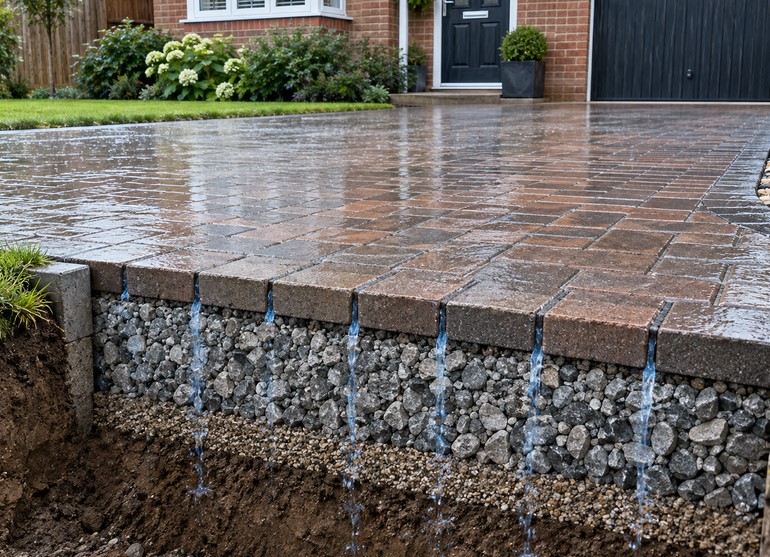
Permeable paving is any driveway surface that lets rainwater soak through it rather than sit on top or run off the edges. The water passes through the surface and into carefully built layers of stone below, where it's stored and then slowly released into the ground.
Compare that to a traditional driveway. Standard concrete, tarmac or non-permeable block paving sheds water sideways towards a gulley, drain or — if the levels are off — your neighbour's garden. Permeable paving flips that around by dealing with the water where it lands.
A couple of quick myth-busters, because these come up a lot:
It's not a magic void. Water doesn't vanish forever. It's stored temporarily in the stone below and released gradually, which is exactly what stops it overwhelming the drains.
Not all block paving is permeable. Two driveways can look identical from the pavement, yet only one lets water through. The difference is in the blocks, the jointing and — crucially — what's underneath.
What is SuDS and why does it matter for driveways?
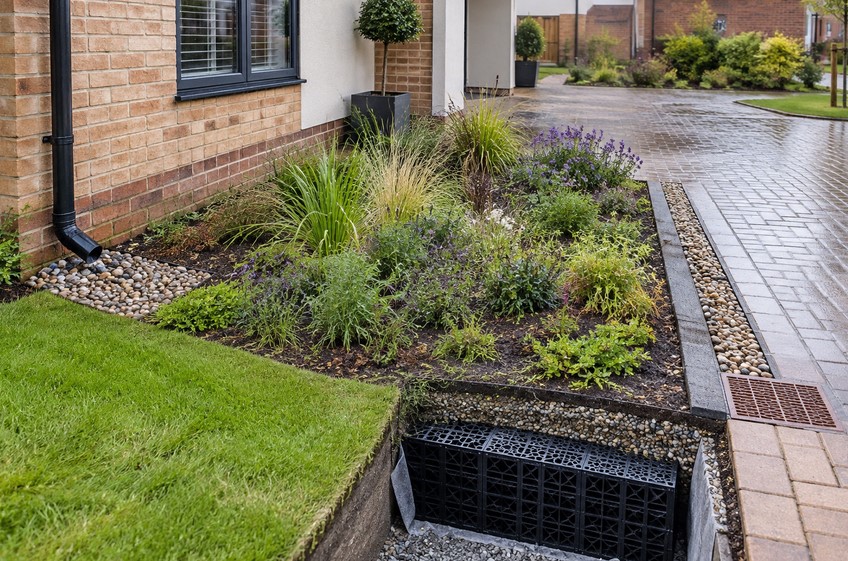
SuDS stands for sustainable drainage systems (you'll sometimes see "sustainable urban drainage systems" too). It's a design approach that manages rainfall close to where it falls, rather than piping it straight off site. For a driveway, that means the rainwater is absorbed and released on your property instead of racing off towards the road.
The goal is easy to remember: slow it, store it, soak it. Instead of rushing rainwater into the sewer, a SuDS approach holds it back, stores it briefly, and lets it drain naturally into the ground.
Why do councils and water companies care so much? Because the drains in most of our older neighbourhoods were built decades ago and simply weren't designed for the amount of rain we now get. The serious UK flooding of 2007 caused an estimated £3 billion in damage, much of it because drains couldn't cope. Every front garden that gets paved over with a solid, non-draining surface adds a little more pressure. One driveway won't tip the balance, but a whole street of them can.
Do I need planning permission for a driveway in the UK?
Quick answer: if your new or replacement driveway uses a permeable surface — or if the rainwater is directed to a lawn or border to soak away naturally — you generally won't need planning permission, regardless of size. This is easily the question we get asked most, so let's clear it up.
The rule changed back in October 2008. Here's the rule of thumb:
Permeable surface (any size): no planning permission needed.
Traditional, non-permeable surface over 5 square metres, with no provision for water to drain to a permeable area: you'll normally need planning permission.
So a well-designed permeable driveway usually keeps you on the right side of the rules without an application form in sight.
A word of caution, though. These allowances apply to houses, not flats or maisonettes, and they don't cover everything. If you live in a conservation area, a listed building, or somewhere with an Article 4 direction, the rules can be stricter. Dropping a kerb to create a new access is a separate permission from your local council entirely.
Our honest advice? Check with your local planning authority for anything unusual, and we're always happy to talk you through the sensible options during a site visit.
What makes a driveway "SuDS compliant"?
A SuDS compliant driveway manages its own rainwater on your property rather than dumping it onto the road or into the foul sewer. In practice, there are two main routes to get there:
A fully permeable surface. This is the most straightforward option. Water drains straight through the surface into the layers below. Job done.
A non-permeable surface that drains to a soakaway or suitable garden area. Here you keep a traditional finish but direct the runoff to a rain garden, border or soakaway where it can soak away naturally.
Which route suits you depends on your soil, your levels, and how much space you've got to play with. Clay-heavy ground drains slowly, for instance, and sometimes needs a bit more thought (occasionally a connection to the roof drains to stop water sitting around too long).
What permeable paving options are there for UK homes?
There's no single "best" surface — it comes down to the look you're after, your budget and how the driveway gets used. As a quick steer: block paving suits those who want a traditional, patterned finish; resin bound works best for a smooth, modern, low-maintenance look; and gravel is ideal when budget and simplicity matter most. Here are the main contenders in more detail.
Permeable block paving
Block paving gives you that classic, characterful driveway look, with plenty of scope for patterns, borders and edging. Permeable versions are laid with special jointing and sit on an open-graded sub-base that lets water pass through the gaps.
The catch, as mentioned earlier, is that not every block paving job is permeable. Proper permeable block paving installation depends entirely on using the right blocks and the right materials underneath. Get that wrong and you've just built a very smart-looking non-permeable driveway.
Resin bound surfacing (when it can be permeable)
Here's a distinction worth knowing: resin bound and resin bonded are not the same thing.
Resin bound mixes the stone and resin together before laying, creating a smooth, permeable surface — water drains straight through.
Resin bonded scatters loose stone onto a layer of resin. It looks textured but isn't permeable, so water runs off.
For a modern, seamless finish that's easy to keep tidy and resists weeds, a properly laid resin bound surface over a permeable base is a popular choice. You can read more about our resin bound driveways if that's the look you're leaning towards.
Gravel (the simple classic)
Gravel is permeable by its very nature and easy on the wallet. It's simple to lay and instantly softens the front of a house. The trade-offs are the ones you'd expect: gravel migrates, scatters and forms waves over time, it can rut under heavy use, and it needs the odd rake and top-up. A strip of block paving or edging at the entrance helps keep it where it belongs.
Porous asphalt and porous concrete
Both exist as permeable options and work well in the right setting, though porous asphalt in particular is a specialist job that needs to be laid by the right people. It's worth knowing they're out there, but for most residential drives, block paving, resin bound or gravel tend to be the more common routes.
What's underneath matters: the layers that make permeable paving work
If there's one message we'd tattoo onto every driveway, it's this: what you can't see matters as much as what you can. A permeable driveway is only as good as its build-up, and this is where corners get cut on cheaper jobs.
A typical permeable build-up, working from the ground up, looks something like this:
Excavation to the right depth — usually around 200–250mm of construction from the finished surface, though ground conditions vary.
A geotextile membrane laid over the soil. This stops the sub-base sinking into the ground below and helps keep weeds at bay.
An open-graded sub-base (materials like Type 3 or 4/20 aggregate). Unlike the standard MOT Type 1 used on conventional drives, these are made of larger stones with open voids between them, so water flows freely and gets stored. Around 150mm is laid and compacted.
A bedding layer and then the surface layer — your blocks, resin or gravel.
Use the wrong sub-base — the fine-filled stuff designed for non-draining driveways — and you've blocked the whole system before you've even finished. It's the single most common mistake we come across. Ground preparation isn't the glamorous part of the job, but it's the part that decides whether your driveway still performs well in ten years' time.
Common mistakes we see (and how to avoid them)
We've been to plenty of jobs to fix driveways that were only a few years old. The usual culprits:
The wrong sub-base, which clogs the system and stops water draining.
Levels running the wrong way, sending water towards the house or out onto the road instead of into the ground.
No edge restraints, so blocks and gravel gradually wander off.
Poor maintenance, letting silt and leaves clog the surface until puddles appear.
Ignoring the ground conditions, particularly on clay soils or where the water table sits high. A quick assessment up front saves a lot of grief later.
How do you maintain a permeable driveway?
The good news is that permeable driveways don't ask for much. A little care keeps them draining freely for years:
Sweep regularly to clear leaves, mud and litter before they clog the surface.
Give it a wash now and then. A careful jet wash or, for larger areas, a vacuum sweep will unclog a tired surface.
Deal with weeds by hand or with a weed burner. Skip the weed killer — it's not doing the environment (or your drainage) any favours.
Watch for standing water. If puddles start appearing where they never used to, that's your surface telling you it's getting blocked and needs a clean.
One thing to avoid: letting soil or sand wash across the surface, or mixing concrete on it. That's the fastest way to clog those all-important pores.
How much does a permeable driveway cost?
We won't quote a figure here because, honestly, every driveway is different. But it helps to know what actually drives the cost:
Size and excavation — bigger area, more digging, more waste to remove.
Ground conditions — soft or clay-heavy ground can mean extra preparation.
Edging, kerbs and gradients — sloping or awkwardly shaped drives take more work.
Access — a tight terrace frontage is a different beast to an open driveway.
Material choice — permeable block paving, resin bound and gravel all sit at different price points.
Drainage extras — a soakaway or rain garden adds to the build if it's needed.
How do I choose the right contractor for a SuDS-friendly driveway?
Not all driveway quotes are comparing like for like, so a few pointed questions will tell you a lot:
What sub-base will you use, and why? The answer should mention an open-graded aggregate for a permeable drive.
How will the runoff be managed? They should have a clear plan for where the water goes.
How are the levels and thresholds set? Water should drain away from the house, not towards it.
What happens at handover? A tidy site and a proper walk-through at the end matter.
For what it's worth, our own process is deliberately straightforward: an initial chat and site visit, honest advice and design ideas, proper ground preparation, and a final tidy and handover once you're happy. No jargon, no vanishing act halfway through the job.
Frequently asked questions
What is the difference between permeable paving and SuDS?
Permeable paving is a type of surface that lets water soak through it. SuDS is the broader design approach to managing rainwater sustainably — permeable paving is one of the tools used to achieve it.
Are permeable paving driveways suitable for the UK climate?
Very much so. Given how much rain we get, a surface designed to absorb and manage rainfall is arguably better suited to the UK than a solid one that sheds every drop towards the drains.
Does a SuDS compliant driveway mean I won't need planning permission?
In most cases, yes. A permeable driveway of any size generally doesn't need planning permission. Just double-check with your local council if you're in a conservation area, own a listed building, or have any other restrictions.
How long does permeable block paving installation take?
It depends on the size of the area and how much preparation is needed — anything from a few days to a couple of weeks. We'll always give you a clear timescale before we start.
Will weeds grow through permeable paving?
Far less than you'd think. A geotextile membrane and regular sweeping keep weeds to a minimum. If any do appear, pull them by hand or use a weed burner rather than weed killer.
Can you install permeable paving over an existing driveway?
Sometimes, depending on the condition of what's already there. Often the better long-term result comes from digging out and rebuilding with the correct permeable layers. We'll assess it and give you an honest recommendation.
What maintenance does a permeable driveway need?
Not much. Sweep it regularly, give it an occasional wash, and keep soil and silt off the surface. That's really the bulk of it.
Is resin bound always permeable?
No. Resin bound is permeable when laid over a permeable base. Resin bonded isn't, because water runs off it rather than through it. If drainage matters to you, resin bound is the one to ask about.
How long does a permeable driveway last?
A properly built permeable driveway should give you well over 20 years of service, provided the layers underneath were laid correctly and you keep the surface swept and clear. As with most things, the quality of the original groundwork is what makes the difference between a driveway that ages gracefully and one that needs redoing far too soon.
Does permeable paving work on clay soil?
Yes, but it needs a bit more thought. Clay drains slowly, so on heavier ground we sometimes design in extra storage within the sub-base, or connect the system to an outlet so water doesn't sit around. It's exactly the sort of thing we check during a site visit before recommending an approach.
Is a permeable driveway suitable for heavier vehicles?
It can be. The key is designing the depth and sub-base to suit the load, so a drive that'll take a large vehicle or the occasional delivery van needs a more robust build-up than one for a small car. Tell your contractor how the drive will be used, and the specification can be tailored accordingly.
Ready to plan a permeable driveway?
A well-built permeable driveway ticks a lot of boxes at once: fewer puddles, smarter drainage, one less planning headache, and a frontage that lifts the whole look of your home. The secret, as ever, is getting the bit beneath the surface right.
If you want a driveway that looks the part and drains properly, we'd love to help. We work across Altrincham, Sale, Timperley, Hale, Bowdon, Hale Barns, Urmston, Stretford, Didsbury, Chorlton and the rest of Greater Manchester, and we're happy to visit, talk through your options and give you honest advice with no pressure.
Give us a call or get in touch for a free quote.

